
Happy Horse and Seedance 2.0 are close enough in raw quality to make the wrong comparison easy. Many buyers treat this as a simple model fight. It is not. The smarter question is which workflow gives you the better output for the way your team actually makes video.
If you want the short answer, Happy Horse is the stronger pick when you care most about fast browser-based execution, benchmark-leading no-audio generation, clearer plan structure, and a product surface that feels ready for daily production work. Seedance 2.0 is the stronger pick when your brief depends on audio-aware generation, richer multimodal references, and more director-like control over scenes, assets, and narrative flow.
If you want to test the browser workflow while you read, Happy Horse is already live.

That distinction matters because the buyer is rarely choosing a benchmark number in isolation. The buyer is choosing a production path. One tool may give you the better first frame. Another may give you the better team workflow, the better commercial path, or the better fit for a specific type of job such as teaser creation, social clips, product demos, or storyboard previews.
This comparison focuses on what matters on April 14, 2026:
- public benchmark position
- text-to-video and image-to-video fit
- audio and multimodal strengths
- pricing clarity and access model
- which tool fits which kind of team
Happy Horse vs Seedance 2.0: The Short Answer
The fastest way to make the right choice is to stop asking which one is "best" and ask what kind of job you are trying to do.
| If your priority is... | Pick... | Why |
|---|---|---|
| Benchmark-leading no-audio quality | Happy Horse | Happy Horse 1.0 currently leads public no-audio text-to-video and image-to-video snapshots |
| Rich multimodal references with audio, video, and image assets | Seedance 2.0 | Seedance 2.0 is designed around multimodal audio-video generation and deeper reference control |
| Fast browser workflow for repeated daily generation | Happy Horse | The product flow is simple: choose mode and model, set options, generate, review, download |
| Audio-aware image-to-video work | Seedance 2.0 | Seedance 2.0 currently edges ahead in public image-to-video with-audio ranking |
| Clear paid plans and commercial usage terms | Happy Horse | The pricing page publishes plan structure, usage tiers, and commercial rights clearly |
| Heavier scene control and multi-asset narrative work | Seedance 2.0 | Dreamina's current Seedance 2.0 flow supports text, image, audio, and video inputs in one project |
The practical answer is simple:
- Pick Happy Horse when you want a production-ready browser workflow and the strongest public no-audio signal.
- Pick Seedance 2.0 when your creative brief depends on audio, multiple reference assets, or more cinematic control.
- Test both when your team makes both teaser-style no-audio clips and heavier multimodal campaign assets.
What You Are Really Comparing
The comparison becomes clearer once you separate platform fit from model fit.
Happy Horse Is a Workflow-First Browser Platform
Happy Horse presents itself as an online AI video generator built around text-to-video and image-to-video workflows in the browser. The product flow is intentionally direct. You enter a prompt or upload a reference image, choose the mode and model, set video options such as aspect ratio, duration, and quality, then generate and download.
That matters because product simplicity is not a cosmetic detail. It changes how often a team actually uses the tool. A workflow that is easy to reopen for daily jobs usually wins more internal adoption than a workflow that feels more powerful but slower to operationalize.
Happy Horse also has a product-level advantage that is easy to miss: the pricing page frames the platform around all core AI models and generation features rather than around a single narrow model access point. That makes the product feel like a broader workspace decision, not just a model bet.
Seedance 2.0 Is a Multimodal Model-First Creative System
Seedance 2.0 is positioned very differently. The official model description emphasizes unified multimodal audio-video generation. The Dreamina workflow around it is designed for creators who want to combine text, images, videos, and audio references inside one creation path.
That creates a different kind of power. Instead of optimizing first for lightweight browser throughput, Seedance 2.0 optimizes for richer control over performance, lighting, shadow, camera movement, and audio-visual alignment. Dreamina's current guide also describes a project structure that can include up to 12 source assets, which is much closer to a directed creative build than a simple prompt-to-video loop.
This is why the headline question should not be "Which model is smarter?" The better question is "Do I need workflow speed or multimodal direction?"
Benchmark Reality on April 14, 2026
Public benchmark data still matters because it tells you where each tool is currently strongest. It should not replace product testing, but it is a credible starting filter.
Here is the current practical snapshot:
| Category | Happy Horse | Seedance 2.0 | What it means |
|---|---|---|---|
| Text-to-video without audio | Publicly framed as #1 | Trails Happy Horse in current public snapshot | Happy Horse has the strongest current proof for prompt-led silent video generation |
| Image-to-video without audio | 1415 Elo | 1358 Elo | Happy Horse is clearly ahead for reference-led no-audio work |
| Image-to-video with audio | 1163 Elo | 1164 Elo | Seedance 2.0 has a razor-thin audio-enabled edge in this category |
| API status in public leaderboard metadata | Coming soon | No API available | Neither looks like a mature open API choice yet, but Happy Horse signals a clearer path |
| Release window in current leaderboard snapshot | April 2026 | March 2026 | Both are recent enough that workflow testing matters more than legacy reputation |
The most important insight is not that one side wins every row. It does not.
The real insight is this:
- Happy Horse has the clearest public advantage in no-audio generation.
- Seedance 2.0 becomes more competitive as soon as audio and multimodal scene construction matter.
- The gap between them is not just about "quality." It is about what kind of creative task the system is optimized to solve.
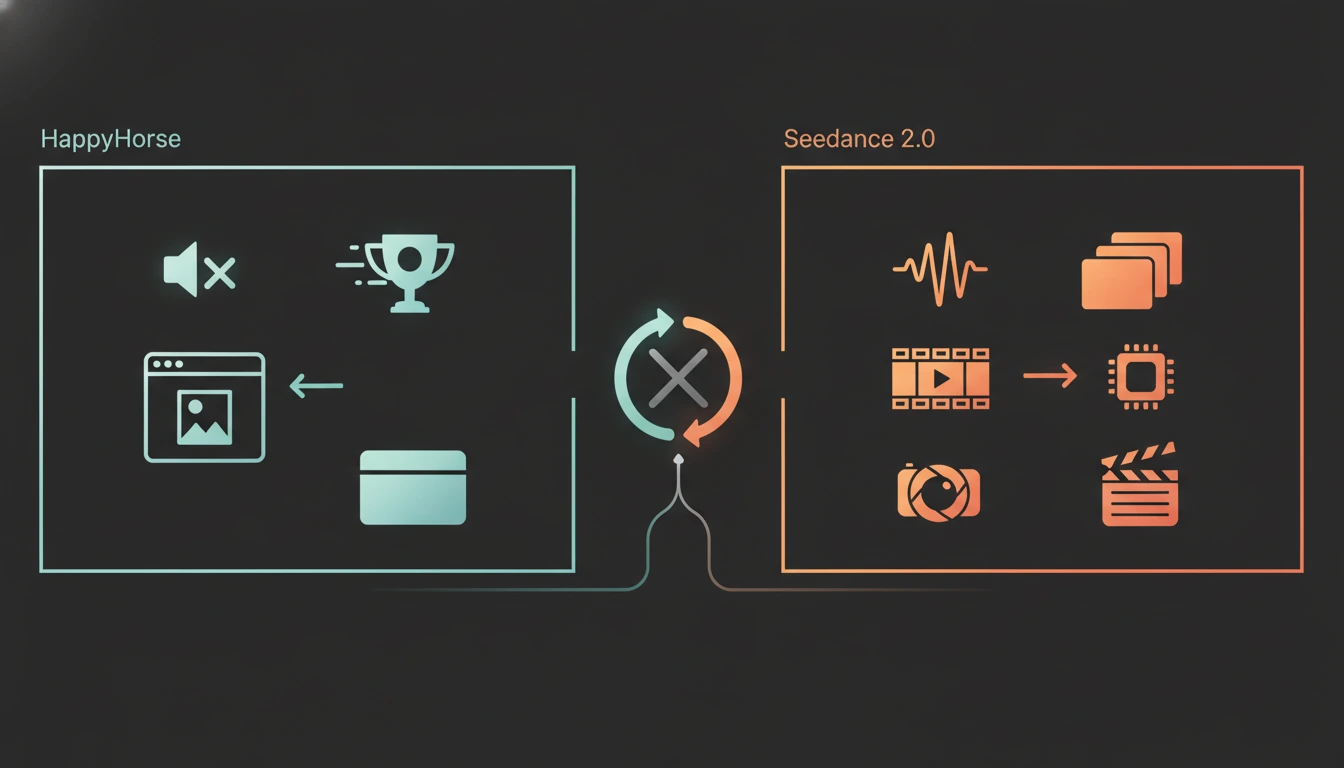
This is why Happy Horse feels stronger for ad hooks, demos, launch teasers, and storyboard previews that often ship without sound first. It is also why Seedance 2.0 feels stronger for projects that are already behaving like a small edit timeline, where reference layering and audio-aware continuity matter.
Workflow Differences That Matter More Than Hype
Features only matter if they change what a team can ship. These are the workflow differences that actually move the decision.
Input Flexibility
Happy Horse starts from a cleaner browser loop. Text prompt in. Image reference in. Mode and model selection. Video options. Generate and iterate. That keeps the cognitive load low, especially for marketers, founders, and product teams that need output fast.
Seedance 2.0 is broader on input structure. The current Dreamina flow supports text, image, audio, and video inputs and lets creators assemble a more layered creative brief. That is not a trivial difference. It changes how much control you can carry into a generation task.
If your team already has a reference stack, Seedance 2.0 can be a better creative fit. If your team mostly needs to move from idea to visible motion quickly, Happy Horse is easier to activate.
Audio and Multi-Scene Work
Audio is the clearest place where Seedance 2.0 keeps pressure on Happy Horse. The official Seedance 2.0 positioning leans hard into audio-video joint generation and immersive audiovisual output. That is consistent with the current public image-to-video with-audio snapshot, where it holds a narrow lead.
That does not make Seedance 2.0 the better pick for every job. It means audio should not be treated as a side note. If the video is supposed to feel complete with sound, narration, transitions, and scene continuity from the first pass, Seedance 2.0 deserves extra weight.
Happy Horse still works well in audio-enabled workflows, but its clearest public advantage remains no-audio work. For many teams, that is enough. A large share of launch clips, social hooks, demo loops, and storyboard drafts begin as silent assets anyway.
Speed, Simplicity, and Team Handoff
Many teams underestimate this point until the third or fourth project. The best creative tool is not just the one that can do the most. It is the one that more people can reopen without friction.
Happy Horse has an advantage here because the product flow is short and production-friendly:
- select the mode
- select the model
- set the options
- generate and review
- rerun fast
That structure lowers the cost of iteration and handoff. It is especially useful when non-specialists need to contribute, such as growth marketers, PMs, or founders preparing launch assets.
Seedance 2.0 is more compelling when the operator is already thinking like a director. If the work depends on multiple inputs, staged references, or carefully guided continuity, the extra control is worth the extra setup.
Pricing Clarity and Commercial Readiness
Happy Horse publishes a clearer buying path today. Its pricing page gives buyers immediate answers about plans, credits, annual equivalents, output ceilings, model access, processing priority, and commercial usage rights. That kind of clarity matters when the tool is being evaluated by a team rather than a solo creator doing one-off experiments.
Seedance 2.0 is easier to try casually in Dreamina because the current tutorial flow explicitly pushes a free start, but it feels more product-specific than procurement-ready. The public benchmark metadata also still lists no public API path for Seedance 2.0. That does not block creative use, but it does affect how teams think about integration, repeatability, and workflow ownership.
Which One Should You Pick for Common Use Cases
The right answer changes by use case. This is where the comparison gets practical.
| Use case | Better fit | Why |
|---|---|---|
| Product launch teaser | Happy Horse | Fast iteration, silent-first strength, clean browser workflow |
| Social ad hook testing | Happy Horse | You usually need volume, speed, and no-audio first-pass testing |
| Storyboard preview for internal review | Happy Horse | Easy to generate and compare quickly without building a complex asset stack |
| Audio-rich brand short | Seedance 2.0 | Better fit when sound and audiovisual continuity matter from the start |
| Multi-asset campaign concept | Seedance 2.0 | Stronger multimodal reference structure |
| Reference-heavy product hero animation | Happy Horse or Seedance 2.0 | Happy Horse if the asset is silent and speed matters; Seedance 2.0 if audio and multi-scene direction matter |
| Team-wide daily browser usage | Happy Horse | Simpler operational fit and clearer commercial plans |
| Creator-led cinematic experiment | Seedance 2.0 | More room for layered control and directed output |
This table also explains why the comparison is so often misread online. Different reviewers are often optimizing for different jobs. A creator making audio-led narrative content can reach a different conclusion from a marketer building silent teaser loops, and both can still be correct.
A Simple Decision Framework
If you need a practical way to choose in one working session, use this framework.
- Start with the output family.
- Is this a teaser, ad hook, demo clip, storyboard preview, or audio-led short?
- Decide whether the first pass needs sound.
- If no, Happy Horse should usually be your first test.
- If yes, Seedance 2.0 deserves immediate comparison.
- Decide how much reference structure you need.
- If you only need a prompt or a single hero image, Happy Horse is usually enough.
- If you need multiple images, video clips, and audio in one creative path, Seedance 2.0 has the better frame.
- Decide who will operate the tool.
- If the workflow must work for a wider product or marketing team, simplicity matters more.
- If a specialist creator is driving the session, richer control may be worth the extra setup.
- Decide how important procurement clarity is.
- If you need visible plans, credits, and commercial terms, Happy Horse is easier to evaluate.
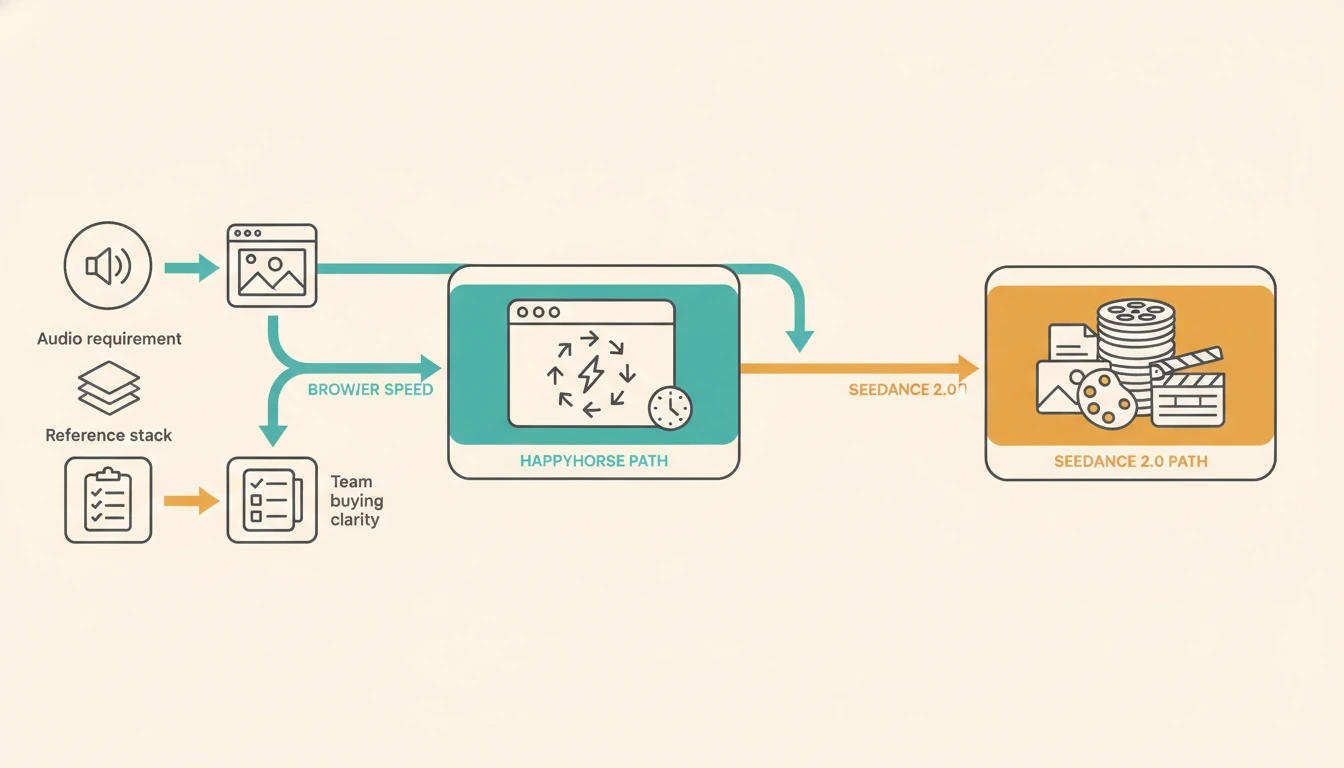
That sequence does a better job than endless side-by-side feature lists because it forces the buyer to match the tool to the job, not the tool to hype.
Where Happy Horse Has the Better Product Fit
Happy Horse has the stronger fit in five situations:
- You want the strongest current no-audio benchmark signal.
- You care about a cleaner browser workflow more than a complex multimodal build.
- Your team makes launch teasers, ads, demos, and storyboard previews more often than audio-led shorts.
- You want clearer pricing and commercial packaging.
- You want a product decision, not only a model decision.
That last point is important. Happy Horse feels like a platform you can keep reopening. That changes how useful it is after the first experiment.
Where Seedance 2.0 Still Has the Edge
Seedance 2.0 has the better fit in four situations:
- Your brief is audio-aware from the first pass.
- You want to combine multiple images, videos, and audio assets in one project.
- You care heavily about cinematic control over camera movement, lighting, and scene continuity.
- You are willing to accept a more directed, creator-led workflow in exchange for richer control.
This is why Seedance 2.0 remains a serious choice even when Happy Horse wins the cleaner no-audio story. The tools are not identical, and the smartest buyers should not pretend they are.
Final Verdict
Happy Horse is the better default recommendation for most teams right now.
That recommendation comes from three things working together:
- the current no-audio benchmark lead
- the simpler browser workflow
- the clearer commercial and pricing surface
If your team mainly produces silent-first launch assets, social clips, product demos, and fast concept videos, Happy Horse is the more efficient bet.
Seedance 2.0 is the better specialist recommendation.
If your team is building richer multimodal scenes, wants tighter audio-visual alignment, or prefers a more director-style creative workflow, Seedance 2.0 still deserves real consideration and may be the better tool for those specific jobs.
The cleanest buying advice is this:
- Pick Happy Horse as the default team workflow.
- Pick Seedance 2.0 when multimodal structure and audio matter more than browser simplicity.
- Keep both in the stack if your pipeline includes both silent-first growth assets and richer cinematic experiments.
FAQ
Is Happy Horse better than Seedance 2.0 overall?
Happy Horse is the better overall pick for most teams because it combines strong public no-audio performance with a simpler browser workflow and clearer pricing. Seedance 2.0 is still a better fit for some audio-aware and multimodal jobs.
Which one is better for text-to-video?
Happy Horse is the safer default pick for text-to-video when the goal is fast, no-audio concept generation. It is the stronger starting point for launch teasers, ad hooks, demos, and storyboard drafts.
Which one is better for image-to-video?
For no-audio image-to-video, Happy Horse currently has the stronger public edge. For with-audio image-to-video, Seedance 2.0 currently has the narrow advantage. The better pick depends on whether sound is part of the first-pass requirement.
Which one is easier for a team to adopt?
Happy Horse is easier for broader team adoption because the workflow is simpler and the paid product structure is clearer. Seedance 2.0 is better suited to users who want more guided creative control and can work with a more layered input setup.
Should I replace Seedance 2.0 with Happy Horse?
You should replace Seedance 2.0 only if most of your current work is silent-first and browser speed matters more than multimodal scene direction. If your team relies on audio, multiple reference assets, or cinematic continuity, Seedance 2.0 still fills a real role.