
The AI video generation landscape shifted dramatically in early 2026 when an anonymous model named Happy Horse 1.0 appeared on the Artificial Analysis Video Arena and immediately claimed the top position, surpassing established players including Google's Veo 3.1, OpenAI's Sora 2 Pro, and Runway's Gen-4.5. Within days, the mystery unraveled: Happy Horse 1.0 was revealed as Alibaba's entry into the AI video race, developed by Zhang Di, the former Vice President of Kuaishou and the technical architect behind Kling AI. The model's arrival was not just another incremental update. It represented a fundamental architectural leap that challenges how video and audio generation should work.
Google's Veo 3.1, meanwhile, has established itself as the premium choice for creators who demand raw photorealism and native 4K output. Ranking third in independent benchmarks with a score of 4.57 out of 5, Veo 3.1 excels at surface detail such as skin pores, fabric weave, and water reflections, delivering what Google describes as stunning realism with breathtaking textures. Yet at $3.20 per video, it costs 4.5 times more than competing models while scoring lower overall.
This guide examines both models across every dimension that matters: architecture, benchmark performance, audio-video synchronization, generation speed, cost, and real-world use cases. Whether you are a content creator evaluating your next production tool, a developer integrating video generation into your application, or a business leader assessing the competitive landscape, this analysis gives you the concrete data you need to make an informed decision.
What Makes Happy Horse 1.0 Different: Architecture and Core Capabilities
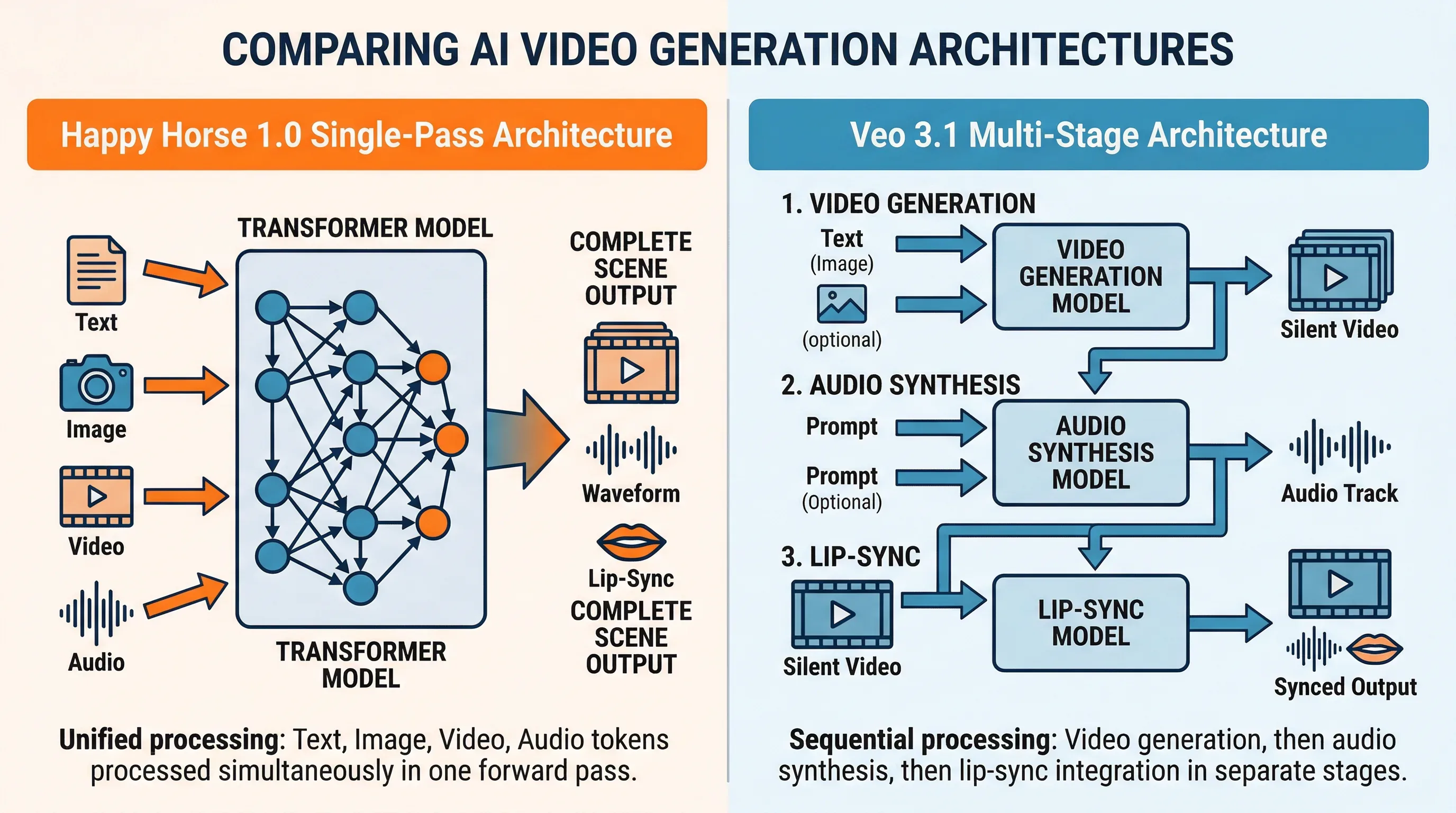
Happy Horse 1.0 is built on a 15-billion-parameter unified Transformer with a 40-layer self-attention architecture. What sets it apart from every major competitor is its single-pass joint audio-video generation. Most AI video models, including Veo 3.1, Seedance 2.0, and Kling 3.0, generate silent video first and then route through separate models for audio, lip-sync, and Foley effects. Happy Horse processes text, image, video, and audio tokens together in one forward pass, meaning the model plans both visual and auditory elements simultaneously rather than dubbing them afterward. This architectural choice delivers tightly synchronized dialogue, ambient sounds, and Foley effects without post-production intervention.
The model employs DMD-2 distillation, reducing denoising to just eight steps without classifier-free guidance. Combined with MagiCompiler-accelerated inference, Happy Horse generates a 5-second clip at 256p in approximately 2 seconds and a full 1080p video in roughly 38 seconds on an H100 GPU. These speeds position it as the fastest open-source AI video model currently available.
Happy Horse supports seven languages with ultra-low word error rate lip-sync: English, Mandarin, Cantonese, Japanese, Korean, German, and French. The phoneme-level synchronization ensures natural, accurate lip movements across all supported languages, enabling multilingual video creation without requiring separate dubbing workflows.
The model handles both text-to-video and image-to-video generation within the same unified pipeline. This is not just a convenience feature. It suggests a single model architecture rather than separate specialized models, which simplifies deployment and reduces infrastructure overhead for teams building production systems.
Happy Horse 1.0 is positioned as fully open-source, with the team promising to release base model weights, distilled model checkpoints, super-resolution modules, and inference code. Commercial usage rights are included, allowing teams to self-host on their own infrastructure and fine-tune for custom use cases. As of mid-April 2026, the official Hugging Face organization page still shows zero public models, meaning the open-source promise remains unverified.
Veo 3.1: Google's Premium Photorealism Engine
Veo 3.1 represents Google DeepMind's iterative refinement of the Veo 3 foundation, focusing on targeted improvements to quality, consistency, and controllability rather than a ground-up redesign. The model produces video at up to 1080p resolution natively, with true 4K output available via upscaling. One of Veo 3.1's signature strengths is temporal consistency. Objects and characters maintain stable appearance across frames without the flickering, warping, or drift that plague cheaper models. Complex scenes with multiple moving elements, realistic lighting changes, and detailed textures are where Veo 3.1 demonstrates its technical maturity.
Google offers three variants within the Veo 3.1 family: standard Veo 3.1, Veo 3.1 Fast, and Veo 3.1 Lite. The standard tier prioritizes output quality and resolution, while Fast and Lite trade some quality for speed and cost efficiency. Veo 3.1 Lite, introduced in March 2026, delivers the same generation speed as Veo 3.1 Fast at less than 50% of the cost, giving developers a lower-friction path for high-volume video applications.
Veo 3.1 is accessible through multiple channels: Google's Gemini API, Vertex AI for enterprise developers, and Google AI Studio for experimentation. Pricing operates on a per-second-of-output basis, with the standard tier running at approximately $0.35 per second of video, translating to roughly $3.20 for a typical 10-second clip. That places Veo 3.1 among the most expensive AI video models on the market.
In rigorous benchmark testing across eight categories, Veo 3.1 scored 36 out of 40 points, outperforming competitors in fluid dynamics and anatomy and motion. Complex physical interactions like water splashes, fabric draping, and human body movement are handled with significantly more accuracy by Veo 3.1 than most rivals. Both Veo 3.1 and several competing models tie at full marks in physics and light rendering for standard scenes, multi-subject interaction, cinematic motion, and text rendering.
Veo 3.1 also features spatial audio generation, adding directional sound cues that correspond to on-screen action. This capability, combined with strong audio-visual synchronization, makes Veo 3.1 particularly well-suited for immersive content, virtual reality applications, and cinematic productions where audio positioning matters.
Benchmark Performance: How They Stack Up
The Artificial Analysis Video Arena ranks models using an Elo rating system derived from blind user comparisons. Users evaluate two videos generated from identical prompts without knowing which model created each clip, then select their preferred output. Higher Elo scores indicate a model is preferred more often in head-to-head matchups.
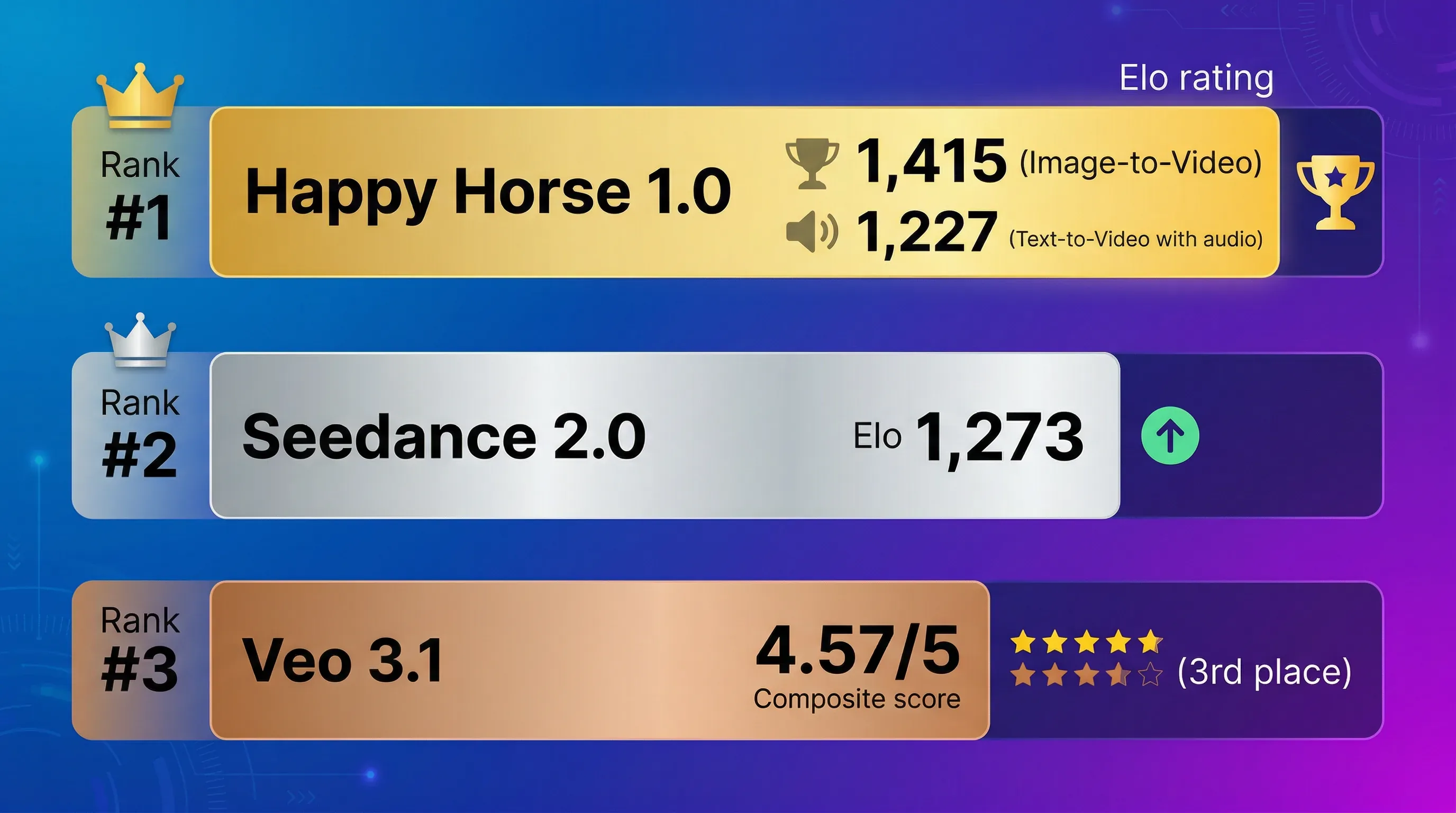
As of April 15, 2026, Happy Horse 1.0 leads the text-to-video arena with an Elo score of 1,227 in the with-audio category and dominates image-to-video with an unprecedented 1,415 Elo. That is a 57-point margin over second-place Seedance 2.0, the largest lead in the arena's history. In text-to-video without audio, Happy Horse scores 1,374, holding a 101-point advantage over Seedance 2.0 at 1,273.
Veo 3.1's position in the Artificial Analysis rankings is less clear-cut. While the model does not appear in the current top five of the with-audio text-to-video leaderboard, independent testing places Veo 3.1 third overall with a composite score of 4.57 out of 5, trailing Seedance 2.0 at 4.70 and Minimax Hailuo 02 at 4.64. Veo 3.1 excels at photorealism and audio quality but falls behind on instruction adherence and character consistency.
The gap between Happy Horse and the rest of the field is statistically meaningful. In the image-to-video arena, the distance between second place and tenth place is roughly 50 Elo points. Happy Horse's 57-point lead over the second-place model represents a tier above the competitive field, not just a marginal edge.
It is worth remembering that Elo scores shift as more votes accumulate, and benchmark contamination remains a risk in any crowded leaderboard. A model that topped rankings in December 2025 may not hold that position in April 2026 as new entrants arrive and existing models receive updates. Even with that caveat, Happy Horse 1.0's dominance across multiple categories, text-to-video, image-to-video, with audio, and without audio, points to broad strength rather than a narrow optimization for one prompt family.
Audio-Video Synchronization: The Defining Battleground
Audio-video synchronization has become the defining battleground in AI video generation. Silent clips were acceptable in 2024. By 2026, native audio generation is table stakes for any model targeting professional use cases.
Happy Horse 1.0's single-pass architecture delivers tightly synchronized dialogue, ambient sounds, and Foley effects because audio tokens live in the same sequence as visual tokens during generation. The model plans both modalities together, which is why the audio feels matched to on-screen action rather than approximately synced after the fact. The ultra-low word error rate lip-sync across seven languages lets creators produce multilingual speaking content without post-production dubbing. That is especially useful for global brands, multilingual marketing campaigns, and localization workflows.
Veo 3.1 also offers strong audio-video synchronization, with independent reviewers noting that it has some of the best native audio-video alignment among publicly available models. Veo 3.1 adds spatial audio with directional cues, making immersive sound positioning a real strength. However, Veo 3.1 still generates audio through separate stages rather than a unified forward pass, which can introduce subtle timing mismatches in complex scenes.
In the Artificial Analysis arena, Happy Horse 1.0 holds first place in text-to-video with audio at 1,227 Elo, while Veo 3.1 is absent from the top five. That suggests Veo 3.1's audio capabilities are strong, but not strong enough to turn into a consistent blind-preference advantage.
For creators building dialogue-heavy content, speaking videos, tutorials, or multilingual campaigns, Happy Horse 1.0's joint audio-video architecture creates a meaningful workflow edge. For immersive content requiring spatial audio positioning such as VR, 360-degree video, or cinematic productions, Veo 3.1's directional audio may justify the premium price.
Speed and Cost: Production Economics
Generation speed and cost per video are critical for teams building production workflows, especially for high-volume applications such as social media content, advertising campaigns, or automated video generation services.
Happy Horse 1.0 generates 1080p video with synchronized audio in approximately 38 seconds on an H100 GPU. The model's DMD-2 distillation and MagiCompiler acceleration deliver industry-leading speed for an open-source model. For lower-resolution previews, Happy Horse produces a 5-second 256p clip in roughly 2 seconds, enabling rapid iteration during creative development.
Veo 3.1 standard takes longer to generate per clip than its Fast and Lite variants. Google prices Veo 3.1 at approximately $0.35 per second of output through the Gemini API and Vertex AI, translating to about $3.20 for a typical 10-second video. That makes Veo 3.1 one of the most expensive AI video models available, costing 4.5 times more than top-ranked alternatives like Seedance 2.0 at $0.70 per video while delivering a lower overall benchmark score.
For developers seeking cost efficiency, Veo 3.1 Lite offers the same generation speed as Veo 3.1 Fast at less than 50% of the cost, though exact pricing still varies by platform and region.
Happy Horse 1.0's open-source positioning promises zero per-generation costs for teams willing to self-host on their own GPU infrastructure. That could be a step-change advantage for high-volume applications, though the upfront capital expense of H100 GPUs and ongoing infrastructure management still matter. As of mid-April 2026, the model weights have not yet been publicly released, so the self-hosting promise remains theoretical.
For teams prioritizing speed and cost efficiency, Happy Horse 1.0 offers the better value proposition if and when the open-source weights become available. For teams requiring immediate production access with enterprise-grade support and SLAs, Veo 3.1's established API infrastructure and Google Cloud integration may still justify the premium despite the higher per-video cost.
Resolution, Aspect Ratios, and Output Flexibility
Resolution and aspect ratio flexibility matter for creators producing content across multiple platforms such as vertical video for TikTok and Instagram Reels, widescreen for YouTube, square for social feeds, and cinematic ultrawide for premium productions.
Happy Horse 1.0 supports output resolutions up to 1080p and multiple aspect ratios including 16:9, 9:16, 4:3, 21:9, and 1:1. The model generates 5-to-8-second video clips with native joint audio generation. Its 1080p output is not produced by simply resizing a lower-resolution generation. Instead, Happy Horse runs a dedicated latent-space super-resolution module, adding five more diffusion steps that reconstruct fine detail before decoding into pixels. That preserves sharpness in textures, facial features, and edges that a simple upscale would smooth away.
Veo 3.1 produces native 1080p video with 4K output available through upscaling. That 4K option positions Veo 3.1 as one of the few AI video models supporting broadcast-grade resolution, making it particularly attractive for advertising agencies, studios, and premium productions where resolution is non-negotiable. Veo 3.1 also supports 60fps output, delivering smoother motion for fast action and moving subjects.
For teams shipping to social platforms and digital channels, Happy Horse 1.0's 1080p output and flexible aspect ratios cover most real-world needs. For teams delivering to broadcast, cinema, or premium streaming environments where 4K is a requirement, Veo 3.1 has the clearer edge.
Model Comparison Table
| Feature | Happy Horse 1.0 | Veo 3.1 |
|---|---|---|
| Architecture | 15B-parameter unified Transformer, 40-layer self-attention | Proprietary Google DeepMind stack |
| Audio Generation | Native joint audio-video, single-pass | Separate-stage audio synthesis |
| Lip-Sync Languages | 7 languages: EN, ZH, YUE, JA, KO, DE, FR | Not specified publicly |
| Resolution | Up to 1080p native | Up to 1080p native, 4K upscaling |
| Aspect Ratios | 16:9, 9:16, 4:3, 21:9, 1:1 | Multiple, not fully specified |
| Generation Speed | ~38s for 1080p on H100 | Varies by tier, standard is slower |
| Text-to-Video Elo (with audio) | 1,227 and ranked #1 | Not in the current top 5 |
| Image-to-Video Elo | 1,415 and ranked #1 | Not in the current top 5 |
| Cost per Video | TBD, open-source self-hosting promise | ~ $3.20 for 10 seconds via API |
| Open Source | Promised, weights not yet released | No, API access only |
| Commercial Use | Yes, once released | Yes, via API |
| Spatial Audio | No | Yes |
| 4K Output | No | Yes, upscaled |
Use Case Recommendations
Different models excel in different scenarios. This is where the decision becomes practical.
Choose Happy Horse 1.0 When:
Multilingual content creation: If you are producing speaking videos, tutorials, or marketing content in multiple languages, Happy Horse 1.0's seven-language lip-sync with ultra-low word error rate removes the need for a separate dubbing workflow. Global brands, international agencies, and localization teams benefit immediately.
High-volume production: Teams generating dozens or hundreds of videos per day, whether for social media calendars, automated video products, or ad campaigns, benefit from Happy Horse's faster generation speed and promised self-hosting economics.
Dialogue-heavy content: The single-pass audio-video architecture keeps dialogue, ambient sound, and Foley aligned. That makes Happy Horse especially strong for narrative clips, explainers, product demos with voiceover, and any scenario where timing matters.
Open-source requirements: Organizations requiring full model control, custom fine-tuning, or on-prem deployment will find Happy Horse's open-source positioning compelling once the release is verified.
Cost-sensitive projects: If per-video cost is the primary constraint and your team can manage GPU infrastructure, Happy Horse's open-source path removes ongoing API fees.
Choose Veo 3.1 When:
4K and broadcast quality: If you are shipping to broadcast TV, cinema, premium streaming, or any channel with a hard 4K requirement, Veo 3.1's upscaling path matters.
Photorealism is non-negotiable: Veo 3.1 wins on surface detail. Skin texture, fabric weave, water reflections, and material realism are still its signature edge. For high-end advertising or luxury content, that may justify the premium.
Immersive and spatial audio: VR applications, 360-degree video, and cinematic productions needing directional sound cues benefit directly from Veo 3.1's spatial audio system.
Enterprise integration: Teams already operating inside Google Cloud, using Vertex AI, or needing enterprise SLAs and support will find Veo 3.1's API stack mature and production-ready.
Immediate production access: Veo 3.1 is available now through multiple channels with clear pricing and established workflows. Happy Horse 1.0's open-source promise still lacks released weights, making Veo 3.1 the safer choice for teams that need guaranteed access today.
The Competitive Landscape: Where Other Models Fit
Although this guide focuses on Happy Horse 1.0 versus Veo 3.1, the broader AI video market includes other relevant contenders.
Seedance 2.0 from ByteDance held the top Artificial Analysis Elo ranking before Happy Horse 1.0's arrival, scoring 1,273 in text-to-video without audio. Seedance excels at multi-shot storytelling with consistent characters and visual style across transitions. However, it remains China-only for now, with global API access expected in Q2 2026, and it faces ongoing legal pressure including litigation from Netflix and scrutiny from the U.S. Congress.
Kling 3.0 from Kuaishou, the company where Happy Horse creator Zhang Di previously worked, generates native 4K at 60fps with stable production access priced at $0.075 per second. Kling 3.0 is currently the most practical choice for global teams needing 4K output today, offering wider availability than Seedance and lower cost than Veo 3.1.
Runway Gen-4.5 held the Elo top spot when it launched in December 2025 before being overtaken by Kling 3.0 and Seedance 2.0 in March 2026. Runway's main advantage remains its ecosystem: motion brush controls, multi-shot workflow tools, scene consistency features, and API maturity that few competitors match.
Sora 2 Pro from OpenAI excels at cinematic long-form coherence but remains expensive and access-restricted. OpenAI announced on March 24, 2026 that the Sora app will shut down on April 26, 2026, with the API following on September 24, 2026. Teams still using Sora should plan migration immediately.
For teams evaluating the full field, Happy Horse provides access to multiple leading AI video models, including Happy Horse 1.0, Seedance 2.0, Kling 3.0, and Veo 3.1, in one workspace. That multi-model setup lets you compare outputs side by side and ship the best result without locking your workflow to one engine.
Technical Considerations for Developers
For developers integrating AI video generation into applications, several factors beyond raw generation quality matter in production.
API maturity and documentation: Veo 3.1 benefits from Google's established API infrastructure, SDKs, and documentation. Gemini API and Vertex AI provide monitoring, support, and enterprise reliability. Happy Horse 1.0's API is still listed as coming soon, which makes Veo 3.1 the safer integration choice today.
Inference infrastructure: Happy Horse 1.0 requires high-performance GPUs such as NVIDIA H100 or A100, with at least 48GB VRAM recommended for self-hosting. The 15B parameter size and 40-layer architecture carry meaningful compute, power, cooling, and maintenance costs.
Model updates and versioning: Google's Veo 3.1 receives managed updates, with improvements rolled out automatically to API users. Open-source models like Happy Horse require manual weight updates, revalidation, and deployment coordination each time a new version arrives.
Rate limits and quotas: Cloud APIs impose quotas and usage limits. Vertex AI can be configured for enterprise workloads, but teams generating thousands of videos daily should still verify quota ceilings. Self-hosted models avoid external rate limits, but your own infrastructure becomes the bottleneck.
Latency and geographic distribution: API-based models add network latency for request and response cycles. Self-hosted models remove that overhead, but a globally distributed cloud provider can still outperform a single-region self-hosted deployment when your users are spread across multiple geographies.
The Open-Source Question: Promise vs. Reality
Happy Horse 1.0's open-source positioning is one of its strongest selling points, but as of mid-April 2026, it remains unverified. The official Happy Horse site describes the model as fully open source with a complete release including base model, distilled model, super-resolution module, and inference code, plus commercial usage rights.
However, the linked Hugging Face organization page still shows zero public models. No weights, no public API, and no reproducible demo are available. That creates a strategic risk for teams planning production around the model.
If the weights are released as promised, Happy Horse could become the dominant open-source video model, enabling fine-tuning, on-prem deployment, and zero per-generation API fees. If the release is delayed or restricted, teams will need to fall back to API access or alternative models.
That question matters more than the leaderboard headline. Teams should watch the official Happy Horse channels closely. Until the weights are public and verified, treat the open-source story as a strong directional signal rather than an operational fact.
Performance Optimization Tips
Regardless of which model you choose, prompt quality and generation parameters still shape the result. These are the practical tuning rules that matter most.
For Happy Horse 1.0:
Detailed prompts work best: Happy Horse responds well to prompts that spell out subject, motion, framing, pacing, and audio intent. Instead of "a person walking," try "a young woman in a red coat walking briskly down a rainy city street at dusk, with ambient traffic sounds and footsteps on wet pavement."
Leverage image-to-video: Happy Horse ranks #1 in image-to-video at 1,415 Elo. For projects requiring specific facial features, brand consistency, or precise composition, start with a reference image rather than text alone.
Multi-language content: When generating multilingual videos, specify the target language clearly in the prompt to improve lip-sync alignment. The model supports English, Mandarin, Cantonese, Japanese, Korean, German, and French.
Iterate at lower resolution: Use 256p previews during creative exploration, then move to final 1080p output once the prompt and composition are dialed in.
For Veo 3.1:
Specify lighting and texture: Veo 3.1 excels at photorealism, so prompts that describe lighting conditions, surface textures, and material properties perform better. "Soft golden hour sunlight filtering through sheer curtains, casting dappled shadows on a linen tablecloth" plays directly to Veo's strengths.
Use Veo 3.1 Lite for volume: If you are generating many variations or testing multiple creative directions, Lite gives you more economical iteration before you upgrade to standard Veo 3.1 for final renders.
Leverage spatial audio: For immersive content, describe audio positioning explicitly in the prompt. For example, footsteps approaching from the left, a door opening off-camera right, or distant traffic fading into the background.
Complex scenes require patience: Veo 3.1 standard is slower than Fast or Lite, but the quality delta becomes measurable in scenes with multiple moving elements and detailed physical interaction.
The Future: What's Coming Next
The AI video market is evolving at extreme speed. Models that topped leaderboards in December 2025 were already overtaken by March 2026. Several trends are defining the next wave.
Longer duration: Current leading models mostly generate 5-to-10-second clips. The next frontier is 30-to-60-second coherent video with stable characters, lighting, and narrative flow.
Higher frame rates: Kling 3.0's 60fps output has already raised the bar. Future models will likely push toward 120fps for smoother playback and slow-motion work.
Better instruction adherence: One of Veo 3.1's clear weaknesses in benchmarking is prompt-following precision. Better natural language understanding will become a major differentiator.
Real-time generation: Current render times range from seconds to minutes. Real-time or near-real-time generation would unlock live streaming, interactive editing, and new real-time media formats.
Unified editing workflows: Runway's ecosystem advantage points toward where the market is going. Standalone generation quality will not be enough. The winning systems will need editing, compositing, and post-production controls built around the model.
Regulatory pressure: Seedance 2.0's legal issues and increasing Congressional scrutiny signal that copyright, training-data provenance, and deepfake concerns are becoming strategic constraints. Transparent training data and robust content authentication will matter more over time.
Conclusion: Which Model Should You Choose?
The answer depends entirely on your requirements, budget, and timeline.
Choose Happy Horse 1.0 if you are producing multilingual content, need tightly synchronized audio-video for dialogue-heavy projects, or care about high-volume generation where cost per video matters. The benchmark lead and promised open-source release make it the more compelling strategic option for teams with the infrastructure to self-host, once the weights actually ship.
Choose Veo 3.1 if you need 4K output for broadcast or premium distribution, require surface-level photorealism for high-end advertising, or already operate inside the Google Cloud ecosystem. Veo 3.1's mature API stack, enterprise support, and immediate availability make it the safer production choice today despite the premium pricing.
Consider a multi-model approach if your workload varies by project. Platforms like Happy Horse give you access to multiple leading AI video models inside one workspace, letting you compare engines side by side and choose the right one for each job instead of forcing every project through the same tool.
The AI video landscape will keep moving quickly throughout 2026. Models will improve, new entrants will appear, and pricing will shift as competition intensifies. The strongest teams will stay flexible, test broadly, and choose the right tool for the specific creative job instead of committing to one model for every scenario.
For now, Happy Horse 1.0 holds the benchmark crown with a unified architecture that challenges conventional multi-stage pipelines. Veo 3.1 remains the premium choice for photorealism and 4K output. Both sit at the current edge of AI video generation, and both will likely be challenged again before the year ends.
The future of video creation is being written in real time, one model release at a time. Stay flexible, test thoroughly, and choose the system that best serves your creative intent.